Introduction
Your smartwatch already knows your heart rate. Your continuous glucose monitor is sending blood sugar readings to your phone every five minutes. A neural implant somewhere in a clinical trial is letting a paralysed patient move a robotic arm using only their thoughts.
This is not a distant future. It is happening right now — and most people have barely heard the name for it: the Internet of Bodies, or IoB.
IOFBodies.com is one of the leading platforms dedicated to explaining, documenting, and helping everyday people understand this fast-moving field. Whether you are a fitness enthusiast curious about the next generation of wearables, a patient managing a chronic condition, a healthcare professional following emerging technology, or simply someone who wants to understand what is being built around and inside the human body, IOFBodies.com applications are the starting point.
This guide covers what the platform is, what the Internet of Bodies actually means in practice, the specific applications transforming health and fitness today, and the critical questions around privacy and ethics that anyone engaging with this technology needs to understand.
What Is IOFBodies.com and Why Does It Matter?

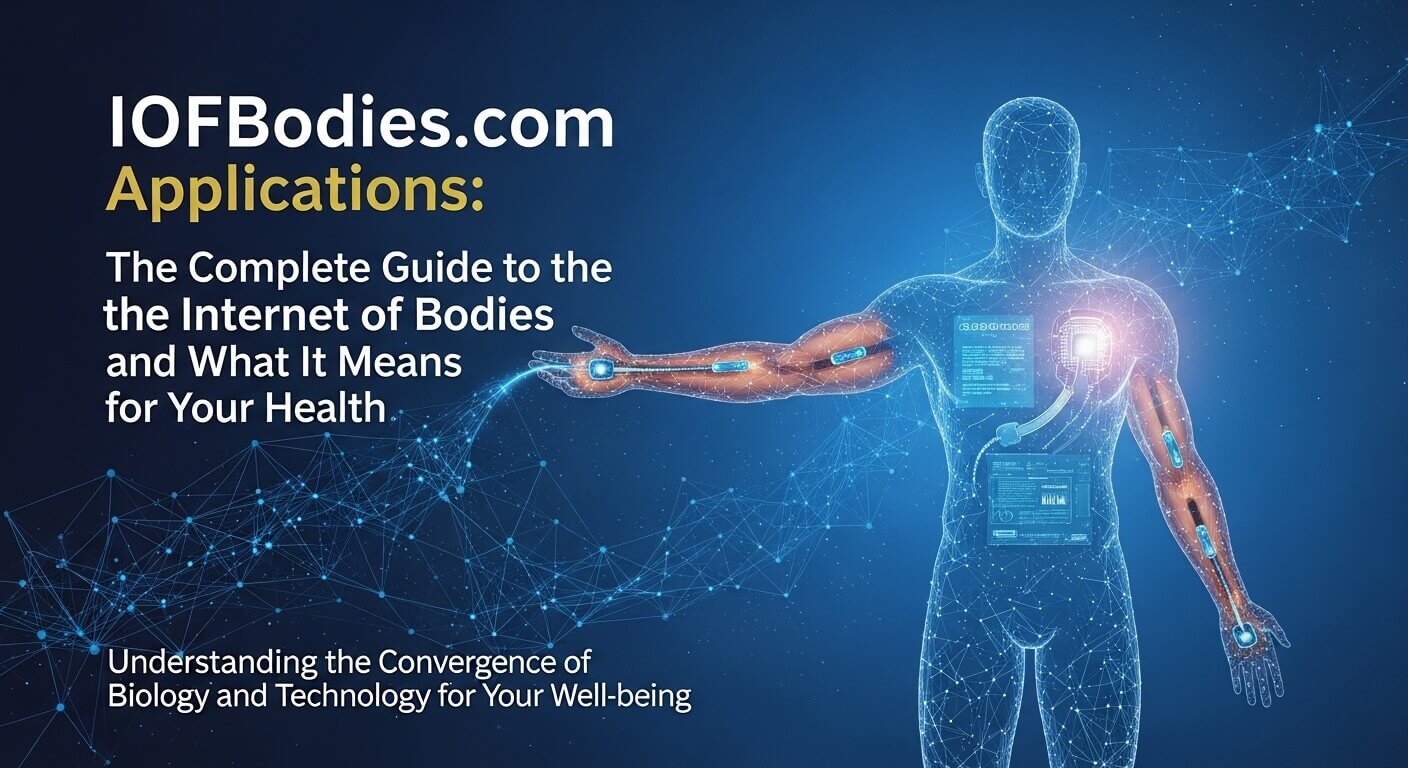
IOFBodies.com is a centralised information and education platform focused on the Internet of Bodies — a rapidly growing field where technology connects with the human body through wearables, implants, sensors, and smart devices. These tools collect data from your body, such as heart rate, blood pressure, sleep cycles, glucose levels, or even brain signals, and connect it to the internet for analysis, monitoring, or action.
The platform’s mission is to break down the complex world of IoB into easy-to-read sections, filled with real-world examples, expert insights, and honest reviews — so that anyone, from tech enthusiasts to health-conscious individuals, can stay informed and confident about the future. Every article is created after careful research and verification from trusted sources, often with the help of experts in health, science, and security.
The Origin of the Internet of Bodies
The term “Internet of Bodies” was first coined by academic and author Andrea M. Matwyshyn in 2016. She described IoB as a network where human bodies’ integrity and functionality are partly dependent on the internet and associated technologies like artificial intelligence. It emerged from the broader Internet of Things (IoT) landscape — the same ecosystem that gave us smart homes, connected appliances, and GPS tracking — but applied directly to human physiology.
That distinction matters enormously. When your fridge connects to the internet, the worst-case scenario is a privacy inconvenience. When your body connects to the internet, the stakes — medical, ethical, and personal — are categorically different.
Why IOFBodies.com Fills a Real Gap
The Internet of Bodies is one of the most significant technological shifts of the 21st century, and it is also one of the least discussed in plain language. Medical journals cover it in technical depth. Tech publications cover the gadget angle. Almost no one bridges the two for ordinary people trying to make informed decisions about the devices they use, wear, or might one day have implanted.
IOFBodies.com applications fill that gap — covering not just how these technologies work, but what they mean for your health, your data, your rights, and your future.
The Main Application Areas of IOFBodies.com
The platform organises its content and tools across several distinct application areas, each addressing a different dimension of how the Internet of Bodies intersects with human life.
Health and Wellness Tracking
This is the most immediately relevant area for most readers. IOFBodies.com health technology content covers how wearable health devices work, provides reviews and buying guides for smart fitness gadgets, offers tips for using IoB devices to lose weight and get fit, and explains how chronic illnesses like diabetes and hypertension can be managed better with IoB.
For people with diabetes, a continuous glucose monitor (CGM) is the difference between checking blood sugar four times a day with a finger prick and having real-time data flowing continuously to a smartphone and shared directly with a doctor. For someone with hypertension, a connected blood pressure cuff that logs every reading over months gives a cardiologist a far richer picture than a single clinic measurement.
IOFBodies.com makes these technologies accessible by explaining them in context — not just what the device does, but why it matters, who it is for, and what the evidence actually says about its effectiveness.
Fitness Optimisation and Performance
Fitness tracking has evolved far beyond counting steps. IOFBodies.com applications for fitness include:
- Body movement and posture analysis — real-time feedback on form during exercise to prevent injury
- Personalised workout planning — AI-driven routines built around your specific biometrics and performance data
- Recovery monitoring — tracking heart rate variability, sleep quality, and muscle fatigue to prevent overtraining
- Nutritional tracking — linking dietary input with measurable health outputs
In 2025, the NFL reported a 20% drop in player injuries after adopting real-time IoB performance tracking. Smart clothing brands like Hexoskin weave sensors into shirts to monitor breathing and movement, giving athletes data that was previously only available in elite sports science laboratories.
The IOFBodies.com platform contextualises these developments — explaining the science behind them, reviewing the products, and helping everyday users understand which tools are worth their investment.
Chronic Disease Management
For the hundreds of millions of people living with long-term health conditions, IoB technology is not a luxury — it is a meaningful shift in quality of care. IOFBodies.com documents these applications in depth, with a focus on practical, real-world use.
Consider a real-world example: a Type 2 diabetic using a continuous glucose monitor connected to IOFBodies.com’s integrated health dashboard. Blood sugar is tracked continuously, patterns are identified over weeks and months, alerts flag dangerous readings before they become emergencies, and the data is shared in real time with a physician who can adjust treatment remotely. This is personalised medicine — and it is available today.
Mental Health Monitoring
One of the more surprising and significant developments in IoB is its application to mental health. Mental health monitoring on the IOFBodies.com platform includes:
- Mood pattern analysis linked to sleep quality, physical activity, and diet
- Stress biomarker tracking through heart rate variability and skin conductance sensors
- Mindfulness and cognitive behavioural therapy tools integrated with biometric feedback
- Environmental health assessment — tracking factors like air quality, noise pollution, and UV exposure that affect mental state
The connection between body data and mental health is one of the most exciting frontiers in this space, and IOFBodies.com is among the first platforms to cover it accessibly for a general audience.
Neural Engineering and Brain-Computer Interfaces
This is the frontier of the Internet of Bodies — and IOFBodies.com does not shy away from it. Brain-computer interfaces (BCIs) allow people to control devices, communicate, or interact with computers using neural signals alone. Innovative implementations include a brain implant that could allow humans to control technology via thought, and Purdue University’s development of a system that turns the human body into a local internet connection, allowing inter-device communication through touch.
For people with paralysis, ALS, or severe physical disabilities, these technologies are already providing life-changing capabilities — not in decades, but now. IOFBodies.com explains what brain-computer interfaces are, how they help people with disabilities regain independence, and what the future of cognitive enhancement and human-machine interaction looks like.
How to Use IOFBodies.com Applications: A Step-by-Step Guide

Getting genuine value from the platform requires more than a single visit. Here is a practical approach to using IOFBodies.com applications effectively.
Step 1: Start with Your Specific Health Goal
The platform covers an enormous range of topics. Beginning with a clear intention — “I want to understand continuous glucose monitors” or “I want to track my sleep more accurately” — will produce far better outcomes than browsing without direction. Use the navigation to find the health technology or application area most relevant to your current situation.
Step 2: Read the Foundational Guides First
Before diving into product reviews or specific device comparisons, invest time in the explanatory content. Understanding what a wearable biosensor actually measures, how the data is processed, and what its limitations are will make every subsequent decision more informed. The platform’s educational articles are specifically designed to build this foundation.
Step 3: Use the Review and Buying Guides for Device Selection
IOFBodies.com applications include detailed reviews and buying guides for IoB devices across categories — fitness wearables, health monitors, smart clothing, and more. When using these:
- Filter by your health goal, not by price or popularity alone.
- Pay attention to data accuracy ratings, not just feature lists.
- Check compatibility notes with your existing devices and operating systems.
- Read the privacy section of each review before committing to a purchase.
Step 4: Update Your Health Metrics Regularly
If you are using the platform’s tracking integrations, consistency is everything. Platforms are continuously changing, so ensure you update your health metrics regularly so that they can give accurate recommendations. A tracker that is not worn consistently produces data that misleads rather than informs.
Step 5: Engage with Community Features
IOFBodies.com allows interactive content via Q&A forums and user-submitted stories, allowing members of the community to exchange experiences while establishing trust. Peer insights from people managing similar conditions or pursuing similar fitness goals add a layer of real-world perspective that no editorial article can replicate.
Step 6: Revisit as Technology Evolves
The Internet of Bodies is a rapidly changing field. New devices, policies, and ethical questions are constantly emerging. The IOFBodies.com platform updates its content regularly, and returning readers will consistently find new research, new product reviews, and new perspectives on how the technology is developing.
Common Mistakes to Avoid When Using IoB Applications

The technology is powerful, but it is easy to misuse or misunderstand — especially for people new to health tech.
Mistake 1: Treating data as a diagnosis. A wearable that flags an irregular heart rhythm is not the same as a cardiologist confirming atrial fibrillation. IoB data is a signal, not a conclusion. It should prompt a conversation with a medical professional, not replace one. Always get professional medical advice before making health decisions based on IoB device data.
Mistake 2: Ignoring the privacy settings. Most people click through consent agreements without reading them. Those agreements determine who has access to your body data, how long it is stored, and whether it can be sold or shared with third parties. IOFBodies.com specifically covers privacy settings and recommendations for each major device category — use this content before setting up any new device.
Mistake 3: Buying for features rather than accuracy. A smart ring that tracks 47 metrics is only useful if the metrics it tracks are accurate. Research consistently shows significant variation in measurement accuracy across consumer IoB devices. IOFBodies.com’s review section specifically addresses accuracy — prioritise that over the feature count.
Mistake 4: Expecting immediate results. IoB devices produce value through patterns observed over time, not single readings. A week of data shows almost nothing. Three months of consistent tracking begin to reveal genuine trends. Set realistic expectations and commit to consistency before evaluating whether a device or platform is working for you.
Mistake 5: Neglecting device maintenance and calibration. Many IoB devices require periodic calibration, software updates, or replacement of sensing components to maintain accuracy. Neglecting these maintenance steps can silently degrade the quality of the data you are acting on — without any warning that the readings have become unreliable.
Mistake 6: Overlooking mental health monitoring tools. Most people who explore IOFBodies.com applications focus entirely on physical health metrics. The mental health and stress monitoring tools are equally sophisticated and often more immediately actionable. Do not bypass them.
Expert Tips for Getting the Most Out of IOFBodies.com Applications
These insights separate people who dabble in health technology from those who genuinely transform their wellbeing with it.
Tip 1: Start with one device, master it, then expand. The temptation when discovering IoB technology is to purchase multiple devices simultaneously — a fitness tracker, a glucose monitor, a sleep ring, a smart scale. Resist this. Each device has a learning curve, and data from multiple sources needs to be interpreted in relation to each other. Start with the single device most relevant to your most important health goal and build from there.
Tip 2: Share your data with your healthcare provider. The most underutilised feature of health IoB devices is the data sharing capability. A continuous three-month record of your resting heart rate, sleep patterns, and activity levels gives your doctor or specialist far more useful information than a single clinic visit. Ask your provider how they prefer to receive IoB data — many now accept exports from major platforms directly.
Tip 3: Understand the ethical landscape before you commit. Consent is a cornerstone of IoB ethics. When you use a fitness tracker, you are signing up for a data relationship — most users click “agree” without reading the fine print that often hides how much data gets collected or who sees it. IOFBodies.com’s ethics and privacy sections are not optional reading. They are the most important content on the platform for long-term users.
Tip 4: Use the platform to prepare for medical appointments. Summarise your IoB data before appointments. Bring printed trends, flag anomalies you have noticed, and ask your doctor specific questions based on what the data shows. This transforms a standard 15-minute GP visit into a data-informed conversation and dramatically improves the quality of medical guidance you receive.
Tip 5: Set goals that the data can actually measure. “I want to be healthier” is not a goal your IoB data can track. “I want to reduce my average resting heart rate from 78 to 68 over 12 weeks through consistent aerobic training” is. The platform’s value multiplies when you connect it to specific, measurable objectives. Set those objectives first, then configure your tracking accordingly.
Key Takeaways
The Internet of Bodies is not a trend. It is a structural shift in how human health is monitored, managed, and understood — and IOFBodies.com is one of the clearest, most accessible guides to navigating it responsibly.
Here is what matters most:
- IoB technology is already here — not coming in a decade. Wearables, CGMs, BCIs, and smart health garments are in use by millions of people today.
- IOFBodies.com bridges the gap between technical complexity and practical understanding, making this field accessible to everyone from beginners to healthcare professionals.
- The health applications are genuinely transformative — for chronic disease management, fitness optimisation, mental health monitoring, and preventive care.
- Privacy is not a secondary concern. Understanding who owns your body data and how it is used is as important as understanding what the data shows.
- Consistency produces value; dabbling does not. IoB technology rewards the patient, consistent user with patterns and insights that single readings never reveal.
- Start with education before you invest in hardware. The foundational content on IOFBodies.com will save you money, protect your data, and ensure you get genuine value from whatever technology you choose.
The human body has always generated data — heartbeats, temperature, blood chemistry, neural signals. For most of history, reading that data required expensive equipment and specialist expertise. The Internet of Bodies, and platforms like IOFBodies.com that help people understand it, are making that data readable, actionable, and genuinely useful for the first time at scale. How you engage with it — thoughtfully or carelessly — will shape your health outcomes in the years ahead.