1. What Is the Iliotibial Band?
The iliotibial band, also called the IT band, is a thick band of connective tissue that runs along the outside of your thigh. It starts near the hip and goes down to the outside of the knee. This band helps support the knee and hip during walking, running, climbing stairs, and many sports movements.
When people talk about a “tight IT band,” they often mean the outside of the thigh feels stiff, sore, or painful. The IT band can become irritated when the muscles around it are tight, weak, or overused. This is why stretching exercises for iliotibial band problems usually focus on the hip, glute, thigh, and lower-body muscles surrounding the band.
2. Why the IT Band Gets Tight
The IT band can feel tight for many reasons. Runners often deal with IT band tightness because repeated bending and straightening of the knee can irritate the outer knee area. Cyclists, hikers, gym-goers, and people who sit for long hours may also experience tightness on the outer thigh.
Weak glutes, tight hip flexors, poor shoes, sudden increases in exercise, running on uneven roads, and poor movement habits can all add stress. Sitting too much can also tighten the hips and make the outer thigh feel stiff. Stretching may help, but lasting relief often comes from a mix of stretching, strengthening, rest, and better movement.
3. Common Symptoms of IT Band Tightness

IT band tightness can feel different from person to person. Some people feel a dull ache along the outer thigh, while others feel sharp pain on the outside of the knee during running or walking downhill. You may also feel tightness near the hip, clicking around the knee, or discomfort after exercise.
The pain may start mild and get worse if you keep pushing through it. Sometimes the outside of the knee feels tender to the touch. If pain is severe, swelling is present, or you cannot walk normally, it is better to stop exercising and speak with a healthcare professional. Stretching should feel helpful, not painful.
4. Do Stretching Exercises for the Iliotibial Band Really Work?
Stretching exercises for iliotibial band tightness can help many people feel better, but it is important to understand how they work. The IT band itself is very strong and does not stretch easily like a muscle.
So when you do IT band stretches, you are mostly stretching the muscles connected to it, such as the tensor fasciae latae, glutes, quads, and hip flexors. These muscles can pull on the IT band and make it feel tight. When they relax and move better, pressure on the IT band may reduce. Stretching is useful, but it works best when combined with strengthening exercises for the hips and glutes.
5. Safety Tips Before You Start Stretching
Before doing any IT band stretch, warm up your body with light movement for five to ten minutes. You can walk, march in place, cycle slowly, or do gentle leg swings. Do not force a stretch when your muscles are cold. Stretching should create a gentle pulling feeling, not sharp pain.
Hold each stretch calmly and breathe slowly. Avoid bouncing because bouncing can irritate the tissue. If you have a recent injury, knee swelling, hip pain, nerve pain, or pain that gets worse during stretching, stop and get advice from a doctor, physiotherapist, or qualified trainer. A safe routine is always better than an aggressive routine.
6. Standing IT Band Stretch
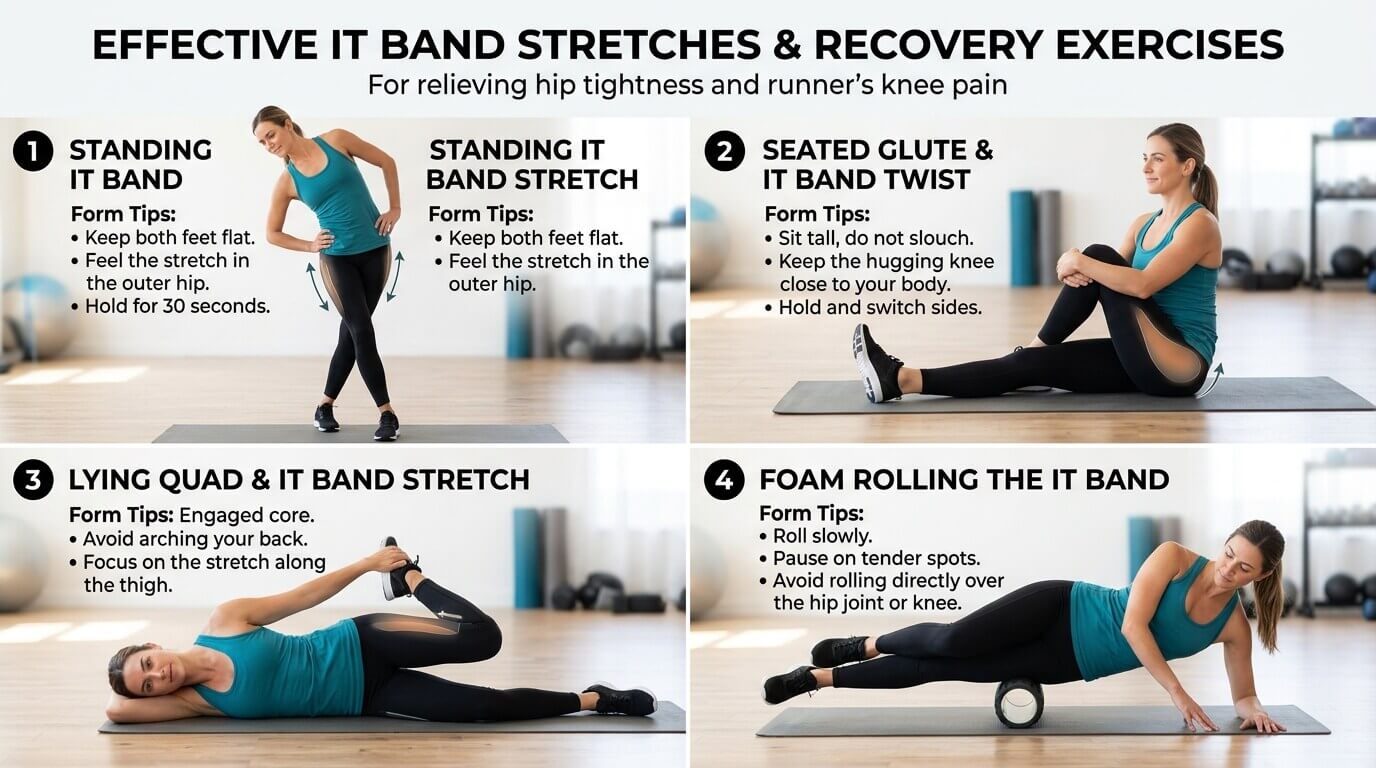
The standing IT band stretch is one of the simplest stretching exercises for iliotibial band tightness. Stand tall near a wall or chair for balance. Cross your right leg behind your left leg. Keep both feet on the floor, then gently lean your upper body to the left while pushing your right hip slightly outward.
You should feel a stretch along the outside of your right hip and thigh. Hold for 20 to 30 seconds, then switch sides. This stretch is easy to do at home, at work, or after a workout. Keep your body relaxed and do not twist too much. The goal is a smooth side stretch, not a deep, painful pull.
7. Cross-Leg Side Bend Stretch
The cross-leg side bend stretch is similar to the standing IT band stretch, but it can feel deeper for some people. Stand with your feet together, then cross one foot behind the other. Raise the arm on the same side as the back leg and reach it overhead. Slowly bend your body away from the back leg until you feel a stretch down the outer hip and thigh.
Hold the position and breathe. This movement helps open the side body, hip, and outer thigh. It is useful after running, walking, cycling, or sitting for long periods. If balance is difficult, do it near a wall so you feel steady.
8. Lying IT Band Stretch With a Strap
A lying IT band stretch with a strap is gentle and controlled. Lie on your back with both legs straight. Place a towel, belt, or yoga strap around your right foot. Lift the right leg toward the ceiling, keeping the knee slightly bent if needed. Slowly guide the leg across your body toward the left side.
Keep your right shoulder on the floor and avoid rolling your whole body over. You should feel a stretch in the outside of the right hip and thigh. Hold for 20 to 30 seconds, then repeat on the other side. This is one of the best stretches for people who want support and control.
9. Seated Figure-Four Glute Stretch
The glute muscles play a big role in IT band tension. If your glutes are tight or weak, the IT band may feel more stressed. To do the seated figure-four stretch, sit on a chair with your feet flat. Place your right ankle over your left thigh, making a number-four shape.
Keep your back straight and gently lean forward until you feel a stretch in your right hip and glute. Hold for 20 to 30 seconds, then switch sides. This stretch is great for office workers because it can be done while sitting. It may not look like an IT band stretch, but it helps release muscles that affect the IT band.
10. Pigeon Pose for Outer Hip Relief
Pigeon pose is a popular yoga stretch for the hips and glutes. Start on your hands and knees. Bring your right knee forward and place it behind your right wrist, then let your right shin angle across the floor. Extend your left leg behind you.
Keep your hips as level as possible and lower your upper body only as far as comfortable. You should feel a deep stretch in the right hip and glute area. Hold for 20 to 45 seconds, then switch sides. If this pose feels too strong, place a pillow under your hip or choose the seated figure-four stretch instead. Never force your knee into an uncomfortable position.
11. Hip Flexor Lunge Stretch
Tight hip flexors can affect the pelvis and increase tension around the IT band. To do a hip flexor lunge stretch, kneel on your right knee with your left foot forward. Keep your chest tall and gently shift your hips forward until you feel a stretch at the front of your right hip.
For a better stretch, squeeze the right glute slightly and avoid arching your lower back. Hold for 20 to 30 seconds, then switch sides. This stretch is very helpful if you sit a lot during the day. When hip flexors loosen, your hips may move better, and your outer thigh may feel less tight.
12. Quad Stretch for Thigh Balance
The quadriceps are the muscles at the front of your thigh, and tight quads can add stress to the knee area. Stand near a wall for balance. Bend your right knee and bring your heel toward your buttock. Hold your ankle or foot with your right hand. Keep your knees close together and your body tall.
You should feel a stretch in the front of the thigh. Hold for 20 to 30 seconds, then switch sides. If you feel knee pain, do not pull hard. Use a strap around your ankle if you cannot reach your foot. A balanced thigh often helps reduce strain around the knee and IT band.
13. Tensor Fasciae Latae Stretch
The tensor fasciae latae, often called the TFL, is a small muscle near the front and outside of the hip. It connects with the IT band, so it is very important for IT band tightness. To stretch it, stand with your right leg crossed behind your left. Turn your right foot slightly inward, then gently push your right hip back and to the side.
Lean your upper body away from the right hip. You should feel the stretch near the outer front part of the hip, not only down the thigh. Hold for 20 to 30 seconds and repeat on the other side. This is one of the most useful stretching exercises for iliotibial band discomfort because it targets a key connected muscle.
14. Foam Rolling the IT Band Area
Foam rolling is not exactly stretching, but many people use it with stretching exercises for iliotibial band relief. Lie on your side with a foam roller under the outer thigh. Use your arms and opposite leg to control pressure.
Roll slowly from just below the hip to just above the knee, but do not roll directly over the knee joint. If the outer thigh is too painful, roll the glutes, quads, and hip area instead. Foam rolling should feel like firm pressure, not torture. Too much pressure can irritate the tissue more. Start with 30 to 60 seconds per side and see how your body responds.
15. Child’s Pose With Side Reach

Child’s pose with a side reach is a gentle stretch that can help the hips, back, and side body relax. Kneel on the floor, sit your hips back toward your heels, and reach your arms forward. Then slowly walk both hands to the left side while keeping your hips back.
You should feel a stretch along the right side of your body and hip. Hold for 20 to 30 seconds, then walk your hands to the right side. This stretch is calming and good after workouts or before bed. It may not directly stretch the IT band, but it helps reduce tension in connected areas.
16. Best Time to Do IT Band Stretches
The best time to do IT band stretches is after a warm-up or after exercise, when the muscles are already warm. Stretching cold muscles can feel uncomfortable and may not work as well. If you run, cycle, or lift weights, stretch after your session. If you feel tight during the day from sitting, walk for a few minutes before stretching.
You can also stretch in the evening as part of a relaxation routine. Consistency matters more than doing one long session. A few minutes daily can help more than one intense stretch session once a week.
17. How Long Should You Hold Each Stretch?
Most people can hold each stretch for 20 to 30 seconds and repeat it two or three times per side. If you are very tight, start with shorter holds and build slowly. Breathe naturally while holding the stretch. Do not hold your breath because that can make your body tense.
If a stretch becomes painful, reduce the pressure or stop. The goal is to teach the muscles to relax, not to fight your body. Over time, your flexibility may improve, but progress can be slow. Be patient and focus on smooth, comfortable movement.
18. Strengthening Matters Too
Stretching alone may not fully solve IT band problems. Weak glutes, weak hips, and poor control of the knee can make the IT band work harder than it should. Simple strengthening exercises like clamshells, side-lying leg raises, glute bridges, step-ups, and band walks can support better hip stability.
When the glutes are stronger, the knee and hip often move with better alignment. This can reduce repeated stress on the IT band. A complete plan should include both stretching and strengthening. If pain keeps returning, a physiotherapist can check your movement and build a plan that fits your body.
19. Common Mistakes to Avoid

One common mistake is pressing too hard into stretches or foam rolling until the area feels bruised. More pain does not mean better results. Another mistake is stretching only the IT band area and ignoring the glutes, hip flexors, quads, and TFL. Many people also return to running or training too quickly before pain has settled.
If your IT band pain is caused by overuse, you may need to reduce activity for a short time. Poor shoes, sudden mileage increases, and weak hips can also keep the problem coming back. Stretch smart, train smart, and listen to your body.
20. When to See a Doctor or Physiotherapist
You should seek professional help if your outer knee or hip pain is sharp, worsening, or not improving after a few weeks of careful stretching and rest. You should also get checked if you have swelling, locking, numbness, weakness, or pain after a fall or injury.
IT band pain can sometimes feel similar to other knee or hip problems, so a proper diagnosis matters. A physiotherapist can test your strength, flexibility, running form, and movement patterns. They can also show you the best stretching exercises for iliotibial band tightness based on your exact problem.
Final Thoughts
Stretching exercises for iliotibial band tightness can be very helpful when done the right way. The key is to stretch the muscles that affect the IT band, including the glutes, TFL, hip flexors, and quads. Gentle stretches, regular movement, foam rolling, and hip strengthening can all work together to reduce tightness and improve comfort.
Do not force deep stretches or push through sharp pain. Start slowly, stay consistent, and give your body time to respond. With a balanced routine and smart training habits, many people can reduce IT band discomfort and move with more freedom.