Introduction
Ever found yourself down a rabbit hole at 2 AM, searching for answers about a health symptom or wellness topic? You’re not alone. According to a 2023 Pew Research study, 77% of health-related searches begin with a search engine, and we’re all looking for trustworthy, accessible health information.
Mega-Personal.net has emerged as one of many platforms claiming to offer comprehensive health archives—collections of articles, guides, and resources covering everything from common ailments to wellness tips. But here’s the million-dollar question: Is the information reliable, and more importantly, is it safe to use?
In this comprehensive guide, we’ll dive deep into what Mega-Personal.net Health Archives actually offers, how to navigate it safely, and what you need to know before trusting your health to online resources. Whether you’re researching a specific condition or just trying to live healthier, understanding how to evaluate online health information could literally save your life.
What Is Mega-Personal.net Health Archives and Why It Matters

Understanding the Platform
Mega-Personal.net Health Archives is a digital repository that aggregates health-related content, articles, and information across various medical and wellness topics. Like many online health databases, it aims to provide accessible information to people seeking answers about health conditions, treatments, and lifestyle improvements.
The platform typically organizes content into categories such as mental health, nutrition, chronic diseases, preventive care, and alternative medicine. Users can search for specific topics or browse through archived articles to find relevant information.
The Growing Need for Online Health Resources
The demand for accessible health information has exploded in recent years. The global health information market is expected to reach $24 billion by 2025, reflecting our society’s increasing reliance on digital health resources.
However, this growth comes with significant risks. Misinformation spreads six times faster than accurate health information on social media, according to MIT research. This makes it crucial to understand not just where you’re getting information, but how to verify its reliability.
Why You Should Care About Where Your Health Information Comes From
Bad health information isn’t just inconvenient—it can be dangerous. People have delayed necessary medical treatment, tried harmful “remedies,” or made serious health decisions based on unreliable online sources. The World Health Organization has even coined the term “infodemic” to describe the overwhelming flood of information—both accurate and false—about health topics.
When you turn to platforms like Mega-Personal.net Health Archives, you’re essentially trusting them with information that could affect your well-being. That trust needs to be earned through transparency, expertise, and accountability.
Key Features and Content You’ll Find in Health Archives
Types of Health Information Available
Most comprehensive health archives, including Mega-Personal.net, organize content into several main categories:
Medical Conditions and Diseases:
- Symptom descriptions and potential causes
- Treatment options and medical procedures
- Disease prevention and risk factors
- Recovery and management strategies
Wellness and Preventive Health:
- Nutrition guides and diet recommendations
- Exercise routines and fitness advice
- Mental health and stress management
- Sleep optimization and healthy habits
Alternative and Complementary Medicine:
- Herbal remedies and supplements
- Holistic health approaches
- Traditional medicine practices
- Integrative health strategies
Specialized Health Topics:
- Women’s and men’s health issues
- Pediatric and elderly care
- Sexual health and reproductive information
- Occupational health and safety
How Content Is Typically Organized
Health archives usually structure information to make it easy to find what you need:
- Search functionality for specific symptoms, conditions, or treatments
- Category browsing by body system, health topic, or demographic
- Alphabetical indices for quick reference
- Related articles that connect to similar topics
- Recent updates highlighting new or revised content
Interactive Features and Tools
Many modern health archives go beyond static articles to offer:
- Symptom checkers (though these should never replace professional diagnosis)
- Health calculators (BMI, calorie needs, risk assessments)
- Video demonstrations of exercises or self-care techniques
- Downloadable guides and worksheets
- Community forums for peer support
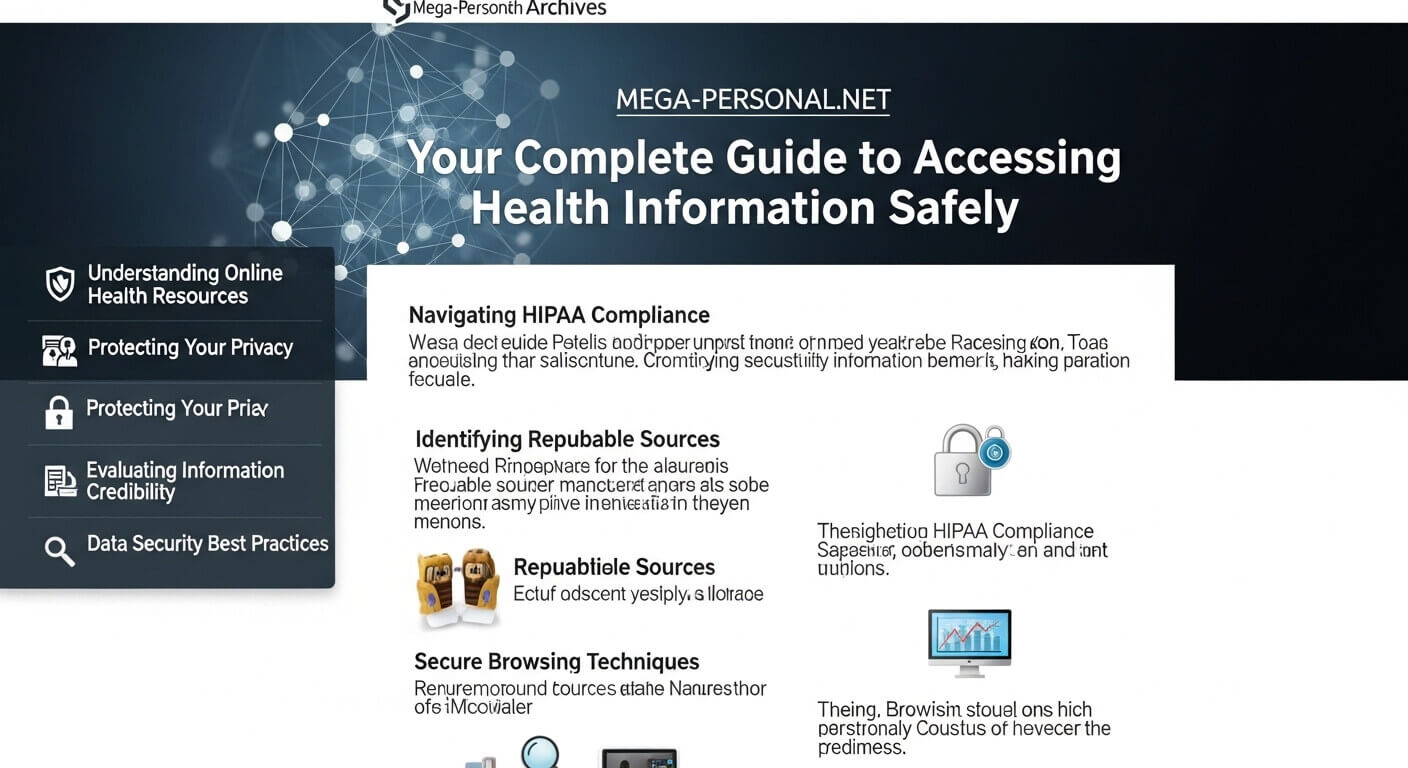
How to Navigate and Use Mega-Personal.net Health Archives Safely
Step 1: Verify the Source Credentials
Before trusting any health information, investigate who’s behind it. Here’s what to look for:
Author Qualifications:
Reliable health content should be written or reviewed by qualified professionals—doctors, registered nurses, licensed nutritionists, or researchers with relevant credentials. Look for author bios that include specific qualifications and institutional affiliations.
Editorial Review Process:
Reputable health sites have editorial boards of medical experts who review content for accuracy. This information is usually found in an “About Us” or “Our Process” section.
Source Citations:
Quality health articles cite peer-reviewed research, established medical organizations, and recognized experts. Be suspicious of articles making claims without any supporting evidence.
Step 2: Evaluate the Content Quality
Not all health information is created equal. Use this checklist to assess quality:
Currency:
- When was the article published or last updated?
- Is the information based on current medical guidelines?
- Have new treatments or research emerged since publication?
Objectivity:
- Does the content present balanced information or promote specific products?
- Are potential conflicts of interest disclosed?
- Does it acknowledge limitations and uncertainties?
Accuracy:
- Can you verify the facts through other reputable sources?
- Does the information align with established medical consensus?
- Are statistics and studies cited correctly and in context?
Step 3: Use the Search Function Effectively
Finding the right information requires strategic searching:
- Start with specific terms rather than vague symptoms
- Use medical terminology when you know it, but don’t be afraid to use common language
- Try different search phrases if you don’t find what you need immediately
- Filter by date to ensure you’re viewing the most current information
- Look for comprehensive articles rather than just headlines or summaries
Step 4: Cross-Reference Multiple Sources
Never rely on a single source for important health decisions. Compare information across:
- Government health websites (CDC, NIH, WHO)
- Major medical institutions (Mayo Clinic, Cleveland Clinic, Johns Hopkins)
- Professional medical associations
- Peer-reviewed medical journals
- Your healthcare provider’s recommendations
If information on Mega-Personal.net contradicts established medical sources, trust the established sources and consult a healthcare professional.
Step 5: Understand What You’re Reading
Medical information can be complex. To ensure you’re understanding correctly:
Break Down Medical Jargon:
Look up unfamiliar terms or use the platform’s glossary if available. Many health archives include simplified explanations alongside technical terms.
Distinguish Between Correlation and Causation:
Just because two things are associated doesn’t mean one causes the other. Be wary of articles that claim definitive cause-and-effect relationships without strong evidence.
Recognize Preliminary Research:
Early studies, animal research, and small sample sizes should be interpreted cautiously. Breakthrough claims often don’t hold up in larger, more rigorous studies.
Step 6: Know When to Seek Professional Help
Online health archives are educational tools, not substitutes for medical care. Seek professional help when:
- You have persistent or severe symptoms
- You’re considering starting or stopping medication
- You need a diagnosis or a personalized treatment plan
- The information you find is confusing or contradictory
- You’re dealing with a mental health crisis or emergency
Think of health archives as a starting point for informed conversations with healthcare providers, not as self-diagnosis tools.
Main Benefits of Using Health Archives Responsibly

Empowering Patient Education
When used correctly, health archives provide tremendous value. Studies show that informed patients tend to have better health outcomes, higher treatment adherence, and greater satisfaction with their care.
Having access to quality health information helps you ask better questions during medical appointments and understand your healthcare provider’s recommendations. This collaborative approach to healthcare leads to more effective treatment and prevention strategies.
24/7 Access to Information
Unlike doctor’s offices that keep business hours, online health archives are available whenever you need them. This accessibility is particularly valuable when you have questions outside normal hours or need information to prepare for an upcoming appointment.
For people in rural areas or those with limited access to healthcare, online resources can provide initial guidance and help determine whether immediate medical attention is necessary.
Cost-Effective Health Education
Quality health information used to require expensive medical textbooks or professional consultations for basic questions. Free or low-cost online archives democratize access to health knowledge, making it available regardless of economic status.
This is particularly important for preventive health information—learning about nutrition, exercise, and disease prevention before problems arise.
Supporting Chronic Disease Management
For people managing ongoing health conditions, archives provide valuable resources for:
- Understanding their condition in depth
- Learning self-management strategies
- Tracking symptoms and triggers
- Finding lifestyle modifications that help
- Connecting with similar experiences through community features
Common Mistakes to Avoid When Using Health Archives
Mistake 1: Self-Diagnosing Instead of Seeking Professional Care
This is the most dangerous mistake people make with online health information. Reading about symptoms and convincing yourself you have a serious condition (or dismissing symptoms as nothing) can lead to delayed treatment or unnecessary anxiety.
Online information should supplement, not replace, professional medical evaluation. Symptoms can have multiple causes, and only a trained healthcare provider can conduct the examinations and tests necessary for accurate diagnosis.
Mistake 2: Following Outdated or Unverified Treatment Advice
Medical knowledge evolves rapidly. A treatment considered standard five years ago might now be outdated or even harmful. Always check publication dates and verify that recommendations align with current medical guidelines.
Be especially cautious about:
- Home remedies without scientific backing
- Supplement recommendations without safety information
- Dosing advice that contradicts medication labels
- Treatments that claim to “cure” conditions considered incurable
Mistake 3: Ignoring Personalized Factors
Health information in archives is generalized. What works for most people might not work for you due to:
- Existing medical conditions
- Medications you’re taking
- Allergies or sensitivities
- Age, pregnancy status, or other demographic factors
- Genetic predispositions
Generic advice can’t account for your unique health profile. Always consider how recommendations might interact with your specific circumstances.
Mistake 4: Falling for Miracle Cure Claims
If something sounds too good to be true, it almost certainly is. Red flags include:
- Promises of quick, effortless results
- Claims that one product cures multiple unrelated conditions
- Testimonials without scientific evidence
- Pressure to purchase specific products
- Conspiracy theories about mainstream medicine
Legitimate health information acknowledges limitations, presents balanced perspectives, and doesn’t push commercial products.
Mistake 5: Sharing Medical Information Without Verification
In our social media age, it’s tempting to share interesting health articles with friends and family. However, spreading unverified information can cause real harm.
Before sharing:
- Verify the information through multiple reputable sources
- Check if the article is outdated
- Consider whether it could cause unnecessary alarm
- Include context about the limitations of the information
Expert Tips for Maximizing Health Archive Value
Tip 1: Create a Health Information Journal
As you research health topics, keep organized notes:
- Document your sources with URLs and publication dates
- Note key points and how they relate to your situation
- List questions to ask your healthcare provider
- Track symptoms and what you learn about them
- Record lifestyle changes you want to try based on research
This journal becomes a valuable tool for medical appointments and helps you track what information you’ve already explored.
Tip 2: Learn to Read Study Summaries
Much health journalism misrepresents scientific studies. When articles cite research, try to find the original study and read at least the abstract. Look for:
Study Design:
- Was it an observational or a controlled experiment?
- How many participants were involved?
- Was it conducted on humans or animals?
- Was there a control group?
Statistical Significance:
Just because something is statistically significant doesn’t mean it’s clinically meaningful. A treatment might show “significant” results but only improve outcomes by a tiny margin.
Funding Sources:
Research funded by companies with vested interests in the results should be viewed more critically than independent research.
Tip 3: Understand Health Risk Communication
When articles discuss health risks, the numbers can be confusing. Here’s how to interpret them:
Relative vs. Absolute Risk:
“This doubles your risk” sounds scary, but if your baseline risk is 0.1%, doubling it to 0.2% is still very low. Always ask: “Double compared to what?”
Number Needed to Treat (NNT):
This tells you how many people need to receive a treatment for one person to benefit. Lower numbers indicate more effective treatments.
Correlation Strength:
Not all correlations are created equal. Look for information about how strong the association is and whether other factors were controlled for.
Tip 4: Build a Trusted Resource List
Not all health websites are equally reliable. Create a personal bookmark folder of vetted resources:
Government Health Organizations:
- CDC (Centers for Disease Control and Prevention)
- NIH (National Institutes of Health)
- FDA (Food and Drug Administration)
- WHO (World Health Organization)
Major Medical Institutions:
- Mayo Clinic
- Cleveland Clinic
- Johns Hopkins Medicine
- Harvard Medical School
Professional Medical Associations:
- American Heart Association
- American Cancer Society
- American Diabetes Association
- Specific associations for your health concerns
Evidence-Based Resources:
- PubMed for peer-reviewed research
- Cochrane Library for systematic reviews
- UpToDate for current clinical information
Use Mega-Personal.net as a starting point, but always cross-reference with these trusted sources.
Tip 5: Recognize Your Biases and Emotional State
When researching health topics—especially about our own symptoms—we’re rarely objective. We tend to:
- Focus on information that confirms what we already suspect
- Remember scary possibilities more than reassuring ones
- Interpret ambiguous symptoms as signs of serious conditions when anxious
Be aware of these tendencies. If you find yourself spiraling into health anxiety, step away from the research and consult a healthcare provider instead.
Tip 6: Use Privacy Protection When Researching Sensitive Topics
Your health searches can reveal sensitive information about you. Protect your privacy by:
- Using private or incognito browsing modes
- Avoiding health searches on public or shared devices
- Being cautious about creating accounts that store your search history
- Reading privacy policies before signing up for health newsletters or services
- Using VPN services when researching particularly sensitive topics
Remember that health archives may track your searches for marketing or other purposes.
Evaluating Specific Health Archive Sections

Mental Health Resources
Mental health information requires extra scrutiny because:
- Conditions are complex and individualized
- Stigma can affect how information is presented
- Self-help strategies vary widely in effectiveness
- Crises require immediate professional intervention
When using mental health sections:
- Prioritize resources created by licensed mental health professionals
- Look for information about when to seek emergency help
- Be skeptical of “cure” claims for conditions like depression or anxiety
- Understand that what helps one person may not help another
Always call emergency services or a crisis hotline if you or someone else is in immediate danger.
Nutrition and Diet Information
Nutrition advice is particularly prone to fads, pseudoscience, and commercial interests. When evaluating diet information:
Red Flags:
- Elimination of entire food groups without medical necessity
- Claims that one food is “toxic” or another is a “superfood.”
- Rigid rules without scientific backing
- Promises of rapid, dramatic weight loss
- Vilification of mainstream nutrition science
Green Flags:
- Balance and moderation are emphasized
- Evidence from registered dietitians or nutrition researchers
- Acknowledgment of individual variation
- Sustainable, long-term approaches
- Alignment with established dietary guidelines
Supplement and Alternative Medicine Information
This is where health archives often become problematic. The supplement industry is poorly regulated, and archived content may be influenced by affiliate marketing.
Critical Questions:
- Are potential side effects and drug interactions clearly listed?
- Is there actual clinical evidence for effectiveness?
- Are dosing guidelines specific and safe?
- Is it clear whether claims are approved by regulatory agencies?
- Are limitations and uncertainties acknowledged?
Never start supplements without discussing them with your healthcare provider, especially if you take prescription medications.
Exercise and Fitness Guidance
While exercise information is generally less risky than medical advice, injuries can still occur from improper technique or inappropriate programs.
Safe Practices:
- Start with beginner-level content if you’re new to exercise
- Look for proper form demonstrations (preferably video)
- Pay attention to contraindications and safety warnings
- Gradually progress rather than jumping into advanced programs
- Consult your doctor before starting vigorous exercise if you have health conditions
Understanding the Business Model Behind Health Archives
How Free Health Archives Make Money
Understanding the financial incentives behind health websites helps you identify potential biases:
Advertising Revenue:
Most free health sites display ads. This isn’t inherently problematic, but it can influence content if advertisers get preferential treatment or if clickbait headlines are used to drive traffic.
Affiliate Marketing:
Sites may earn commissions when you purchase products they recommend. This creates incentives to promote products regardless of whether they’re the best option.
Sponsored Content:
Some articles may be paid for by companies, though reputable sites clearly label this. Be extra skeptical of sponsored health content.
Data Collection:
Your search patterns, demographics, and interests have value. Some platforms monetize by selling anonymized (or not-so-anonymized) user data.
Recognizing Content Marketing vs. Education
True educational content aims to inform. Content marketing aims to sell. Sometimes the line blurs. Watch for:
- Articles that consistently recommend specific brand-name products
- Content that creates problems, their advertised solutions conveniently solve
- Oversimplified explanations that steer toward particular products
- Lack of alternative options or approaches
When Health Archives Fall Short: Alternative Resources
Situations Requiring Professional Medical Sources
Some situations demand more than general health archives:
Rare or Complex Conditions:
General archives may lack detailed, current information about uncommon conditions. Seek specialty organizations and academic medical centers instead.
Contradictory Information:
When you find conflicting advice, professional medical databases like UpToDate or consulting with specialists provide clarity.
Personalized Treatment Decisions:
Generic information can’t account for your unique medical history, genetics, and circumstances. These decisions require individual medical consultation.
Better Alternatives for Specific Needs
For Current Research:
- Google Scholar
- PubMed Central
- Specialty medical journals
For Patient Communities:
- Patient advocacy organizations
- Condition-specific support groups (vetted carefully)
- Hospital-sponsored patient education programs
For Immediate Questions:
- Nurse advice lines (often provided by insurance)
- Patient portals with secure messaging to your care team
- Telehealth consultations for non-emergency concerns
Red Flags: When to Avoid a Health Archive Entirely
Warning Signs of Unreliable Health Information
Some red flags should make you immediately skeptical of a health resource:
- No clear ownership or editorial team listed
- Predominantly commercial, with products heavily promoted
- Conspiracy theories about mainstream medicine
- Extreme claims without substantial evidence
- Poor quality with obvious typos, broken links, or outdated design
- No contact information for questions or concerns
- Anonymous authors without credentials
- Copied content from other sites without attribution
If Mega-Personal.net or any health archive displays multiple red flags, seek information elsewhere.
The Danger of Echo Chambers
Some health archives cater to specific ideologies—anti-vaccination, alternative medicine only, extreme diet philosophies. These echo chambers reinforce existing beliefs rather than providing balanced information.
Be especially cautious when:
- All content aligns with one particular viewpoint
- Mainstream medical science is consistently dismissed
- Information contradicts established medical consensus without compelling evidence
- Community features become hostile to different perspectives
Conclusion: Key Takeaways for Using Health Archives Wisely
Health archives like Mega-Personal.net can be valuable educational tools when used thoughtfully and critically. However, they’re supplements to—not replacements for—professional medical care and advice.
Before Trusting Any Health Archive:
- Verify author credentials and editorial oversight
- Check for citations to reputable medical sources
- Assess whether content is current and regularly updated
- Understand the site’s business model and potential biases
When Using Health Information:
- Cross-reference across multiple reputable sources
- Distinguish between general education and personalized medical advice
- Be aware of your own biases and emotional state while researching
- Keep organized notes with sources and dates
Recognize Your Limits:
- Don’t self-diagnose based solely on online information
- Understand when a professional medical evaluation is necessary
- Know that general advice may not apply to your specific situation
- Be skeptical of miracle cures and dramatic claims
Protect Yourself:
- Maintain privacy when researching sensitive health topics
- Avoid sharing unverified medical information with others
- Build a collection of truly trustworthy health resources
- Stay current with how to evaluate health information quality
The Bottom Line:
In an age of information overload, your ability to critically evaluate health resources is a vital life skill. Mega-Personal.net and similar archives can provide helpful starting points for health education, but they work best as part of a comprehensive approach that includes professional medical guidance, reputable institutional sources, and your own informed judgment.
Your health is too important to trust to any single source—online or otherwise. Stay curious, stay critical, and most importantly, stay in communication with qualified healthcare providers who know your individual health needs.
Remember: Knowledge is power, but wisdom is knowing when to seek expert help. Use health archives to become an informed patient, not to become your own doctor.