Introduction
There is a moment that happens the first time you cut into a ball of burrata. The outer shell parts, and something impossibly creamy and soft spills out onto the plate. That silky, ribbon-like filling that makes everyone at the table lean in and say what is that? — That is stracciatella cheese.
It is one of Italy’s great culinary secrets. Not as famous as Parmigiano Reggiano or as widely recognised as mozzarella, but arguably more indulgent than either. Once you understand what stracciatella cheese is, how it is made, and the remarkable range of ways you can eat it, it will earn a permanent place on your shopping list.
This guide covers everything — the origins, the production process, the flavour profile, how to cook with it, how to store it, and what mistakes to avoid when you bring it home.
What Is Stracciatella Cheese?
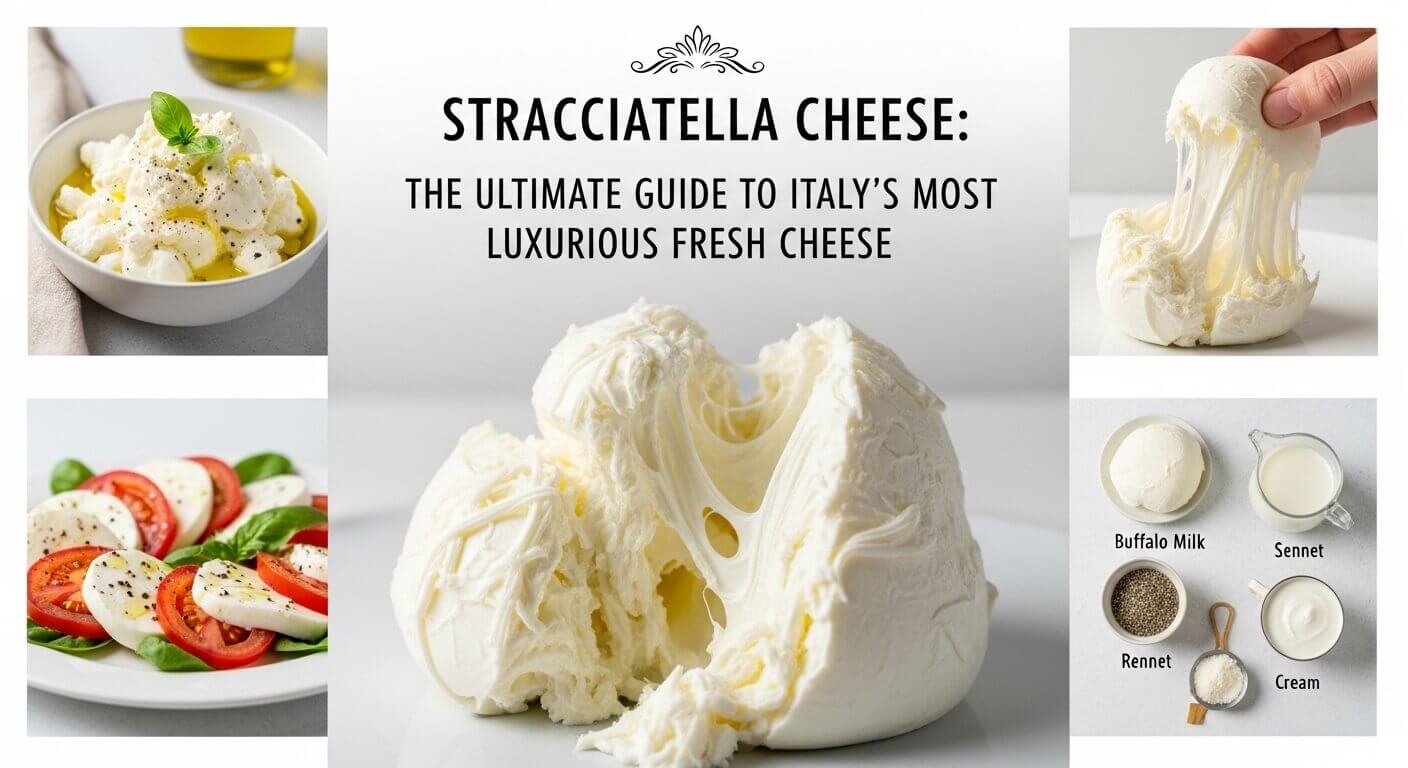
Stracciatella cheese is a fresh Italian pasta filata cheese made by shredding mozzarella curd into thin strands and mixing those strands with rich, fresh cream. The result is a soft, spoonable, luxuriously creamy cheese that sits somewhere between solid and liquid — too thick to pour but too loose to slice.
The name comes from the Italian word stracciare, meaning to shred or tear. Stracciatella translates roughly to “little rags” or “little shreds” — a direct reference to the torn strands of mozzarella that form its texture.
It is most familiar to most people as the filling inside burrata. That gloriously creamy interior that makes burrata richer and more complex than regular mozzarella? That is stracciatella. The cheese exists independently as well, sold on its own in tubs or small containers, and it is every bit as wonderful without the mozzarella shell around it.
The Three Stracciatellas
Worth noting before we go further: stracciatella is technically the name for three distinct Italian foods, and understanding the difference avoids confusion at markets and menus.
- Stracciatella cheese — the creamy pulled-curd and cream mixture discussed throughout this article
- Stracciatella alla Romana — a Roman egg-drop soup where beaten eggs are whisked into hot meat broth, forming delicate shreds resembling the cheese
- Stracciatella gelato — a white cream-based gelato studded with fine shards of dark chocolate, created in Bergamo in 1961 by Enrico Panattoni, who drew inspiration from the look of the soup
The thread connecting all three is the visual: shreds, strands, or fragments suspended in something smooth and creamy.
The Origins of Stracciatella Cheese

Stracciatella cheese originates from Puglia, the region that forms the heel of Italy’s boot-shaped peninsula. More specifically, it is linked to the province of Foggia and the broader Apulia region, where buffalo dairy farming has been central to food culture for centuries.
The cheese was created at the beginning of the 20th century as a practical solution to a common problem. During mozzarella production, imperfect pieces and leftover curds accumulated — too small or irregular to be formed into proper balls. Rather than discard them, cheesemakers in the region began shredding these scraps by hand, mixing them with fresh cream, and selling the result as its own product.
What started as a way to avoid waste became one of Italy’s most celebrated fresh cheeses. Traditional artisanal producers still make stracciatella in small batches, and it is sold locally because its shelf life is so short — typically just a few days after production. In Italy, the freshest stracciatella comes from dairies in Andria and across the Murgia plateau, the same area credited with creating burrata in the early 1900s.
Stracciatella was brought to the United States primarily by Italian immigrants from the Puglia region, and it is now produced by several American cheesemakers using cow’s milk as a substitute for the traditional water buffalo milk.
How Stracciatella Cheese Is Made
The production of stracciatella cheese follows the same opening steps as mozzarella before diverging at a critical stage.
The Full Production Process
- Milk selection and curdling. High-quality milk — traditionally from water buffalo, though cow’s milk is widely used — is warmed and treated with cultures and rennet. The milk curdles, separating into solid curds and liquid whey.
- Draining and heating the curds. The curds are cut, drained, and then immersed in hot water (typically around 85–90°C). This is the pasta filata stage — the defining technique of southern Italian stretched-curd cheeses, shared with mozzarella, provolone, and caciocavallo.
- Stretching the curd. The heated curds become elastic and pliable. A cheesemaker works them by hand, pulling and stretching until they develop a smooth, glossy surface.
- Shredding rather than forming. Here is where stracciatella diverges from mozzarella. Instead of forming the stretched curd into balls or braids, the cheesemaker tears and shreds it by hand into thin, irregular strands — those characteristic “little rags.”
- Mix with fresh cream. The shredded curd is immediately mixed with rich, fresh cream. The cream is partly absorbed by the warm curd, thickening and enriching the mixture. Salt is added at this stage.
- Resting and packaging. After a brief rest, the stracciatella is transferred into containers — packed in cream or lightly salted water — and refrigerated. It is ready to eat within hours and is at its peak within the first two to three days.
Authentic stracciatella made from cultured mozzarella develops a subtly more complex character during production. Living microorganisms in the cultured cheese slowly digest the lactose in the cream, thickening it and developing gentle umami notes. Versions made with acid-set mozzarella are simpler and fresher-tasting, closer to pure milk and cream. Both are excellent — the cultured version simply has more depth.
What Does Stracciatella Cheese Taste Like?
The flavour profile of stracciatella cheese is mild, clean, and deeply creamy. There is a gentle sweetness from the fresh milk, a barely-there tang from the lactic fermentation, and a rich butterfat quality from the cream. It does not have the sharpness of aged cheeses or the pronounced tang of goat’s milk varieties.
The texture is almost as important as the flavour. It is silky and soft — thick enough to hold its shape when spooned but loose enough to melt into warm pasta or pool gently on toast. The shredded strands of mozzarella provide the slightest structural element within the creaminess, giving each bite a subtle, pleasant pull.
It tastes, in a word, luxurious. Rich without being heavy, creamy without being cloying, fresh and alive in a way that only truly fresh cheese can be.
The Nutritional Profile of Stracciatella Cheese
Stracciatella is a rich cheese, and its nutritional content reflects that. Per 100 grams, it contains approximately:
- Calories: 250–290 kcal
- Fat: 22–25g (of which saturated fat: 14–16g)
- Protein: 10–12g
- Carbohydrates: 2–3g
- Calcium: Around 200mg (approximately 20% of the daily recommended intake)
- Sodium: Variable depending on the producer, typically 200–400mg
It is a good source of calcium and protein, and like all fresh dairy, it provides phosphorus, B vitamins, and zinc. The fat content is significant — this is not a low-calorie ingredient. But consumed in the portions typical of Italian cooking, it contributes meaningful nutrition alongside genuine flavour.
People with lactose intolerance may find stracciatella easier to tolerate than aged cheeses in some cases, as the culturing process reduces lactose content, though individual sensitivity varies.
How to Eat and Cook with Stracciatella Cheese

Stracciatella cheese is one of the most versatile fresh cheeses available. It works equally well as a simple showpiece with bread and oil as it does integrated into more complex recipes.
Serving Stracciatella Raw
The simplest preparations are often the best. Remove stracciatella from the refrigerator at least 30 minutes before serving — cold temperatures mute its flavour and stiffen its texture. At room temperature, its creaminess blooms fully.
Best raw preparations:
- On bruschetta — toasted bread rubbed with garlic, topped generously with stracciatella, finished with flaky sea salt, cracked black pepper, and a pour of extra-virgin olive oil
- Caprese variation — substitute stracciatella for mozzarella in a classic caprese, paired with ripe tomatoes, fresh basil, and a thread of good balsamic
- On a cheese board — serve alongside cured meats, olives, and crusty bread with a small spoon; let guests help themselves
- With roasted vegetables — honey-roasted figs, balsamic-glazed beetroot, or caramelised squash alongside a generous spoonful of stracciatella
Using Stracciatella in Cooked Dishes
Stracciatella should never be cooked in the traditional sense — heat ruins its delicate texture and causes the cream to separate. The technique is always to add it after cooking, using residual heat to warm it gently.
Best cooked applications:
- On pasta — add a generous dollop to hot spaghetti, linguine, or rigatoni straight after draining. The heat of the pasta warms the stracciatella into a silky sauce. Works beautifully with tomato-based, pesto, or simple olive oil and garlic sauces.
- On pizza — add stracciatella immediately after the pizza leaves the oven. The residual heat softens it without cooking it, creating pools of creaminess across the surface.
- On risotto — stir through a spoonful in the final 30 seconds of cooking to replace or supplement the traditional butter and Parmesan finishing technique.
- On grain bowls — a dollop of stracciatella transforms a bowl of farro, quinoa, or bulgur wheat with roasted vegetables into something genuinely special.
- With eggs — serve alongside fried or poached eggs on toast, or drop a spoonful into scrambled eggs just before they set.
Stracciatella Cheese vs. Similar Cheeses
Understanding where stracciatella sits among related Italian fresh cheeses helps you choose the right one for your purpose.
Stracciatella vs. Burrata
Burrata is stracciatella enclosed in a thin pouch of mozzarella. The outer shell is stretched mozzarella; the filling is stracciatella mixed with additional cream. If you love burrata specifically for its interior, buying stracciatella directly gives you more of what you are actually after, often at a lower cost and without the presentation element. For an elegant dinner party presentation, burrata is the choice. For everyday cooking and generous portions on pasta or toast, stracciatella is the more practical option.
Stracciatella vs. Mozzarella
Mozzarella and stracciatella share the same curd base, but the processing produces entirely different products. Mozzarella is firm enough to slice, holds its shape in cooking, and has a more neutral, milky flavour. Stracciatella is spoonable, dissolves into warm dishes, and is noticeably richer and creamier. They are not direct substitutes — choosing between them depends on the application.
Stracciatella vs. Ricotta
Both are soft, white, and mildly flavoured, but they are made very differently. Ricotta is produced from reheated whey; stracciatella from stretched mozzarella curd and cream. Ricotta is grainier and lighter; stracciatella is smoother and richer. Ricotta works better in baked applications; stracciatella in fresh or just-warmed ones.
How to Store Stracciatella Cheese
Stracciatella is a fresh cheese with a very short shelf life. Proper storage is essential.
- Refrigerate immediately after purchase. Keep at 0–4°C.
- Consume within 2–3 days of purchase for best quality. Most commercial packaging has a shelf life of around 12 days, but quality deteriorates noticeably after the first few days of opening.
- Store in its original liquid — cream, brine, or water — to prevent the cheese from drying out.
- Do not freeze. Freezing destroys the texture irreparably, causing the cream to separate and the curd to become grainy.
- Remove from the refrigerator 30 minutes before eating to allow the flavour and texture to come to their full potential.
Common Mistakes to Avoid with Stracciatella Cheese
Even simple ingredients are easy to mishandle. These are the most frequent errors.
Mistake 1: Eating it straight from the refrigerator. Cold stracciatella is dense, slightly stiff, and muted in flavour. Room temperature stracciatella is a completely different experience — looser, creamier, and dramatically more flavourful. This is the single most impactful adjustment you can make.
Mistake 2: Adding it to dishes while they are actively cooking. Stracciatella does not survive direct heat. The cream separates, the curd turns rubbery, and the elegance is lost. Always add it at the very end, off the heat, and let the warmth of the dish do the work gently.
Mistake 3: Buying it and waiting too long to eat it. This is not a cheese you buy on Thursday for a Sunday dinner. Buy it one to two days before you plan to eat it, at most. Better still, buy it the same day.
Mistake 4: Using mediocre olive oil. Because stracciatella is so mild and clean in flavour, the quality of what you pair it with matters enormously. A pour of supermarket olive oil and a pinch of table salt produces a forgettable result. The same cheese with cold-pressed extra-virgin olive oil and flaky sea salt is genuinely revelatory.
Mistake 5: Over-complicating the dish. Stracciatella is an ingredient that performs best when treated simply. Resist the urge to layer it with too many competing flavours. Two or three complementary elements — bread, tomato, basil; pasta, garlic, lemon; pizza, prosciutto, rocket — serve the cheese far better than a complex construction.
Expert Tips for Getting the Best from Stracciatella Cheese

Tip 1: Season with restraint. Stracciatella is already mildly salty from its production. Taste before adding more salt, and when you do season, use flaky sea salt rather than fine salt — the texture of the flakes adds a pleasant contrast.
Tip 2: Pair with acid. The richness of stracciatella craves something acidic alongside it. Ripe tomatoes, a squeeze of lemon, a light balsamic reduction, or pickled vegetables cut through the creaminess and bring everything into balance.
Tip 3: Use it as a burrata substitute. Any recipe that calls for burrata can be made with stracciatella instead. Simply spoon it into position rather than placing a whole ball. The flavour and richness are identical; only the presentation differs.
Tip 4: Drizzle with something interesting. Honey, good chilli oil, truffle oil, or pumpkin seed oil — each takes stracciatella in a completely different direction. A drizzle of quality honey over stracciatella on toasted sourdough, finished with fresh thyme and walnuts, is one of the great simple pleasures of an Italian-inspired kitchen.
Tip 5: Try it with cured meat. Stracciatella alongside thinly sliced prosciutto crudo, coppa, or bresaola is a classic Italian pairing. The saltiness and slight funk of the cured meat provide a perfect counterpoint to the fresh, milky creaminess of the cheese.
Key Takeaways
Stracciatella cheese is one of Italy’s most remarkable and underrated dairy products — born from a waste-reduction practice in early 20th-century Puglia, refined over generations into something genuinely extraordinary.
Here is what to carry forward:
- It is the filling of burrata — if you have eaten burrata and loved it, you have already tasted stracciatella.
- Made from shredded mozzarella curd and fresh cream — simple ingredients, exceptional results.
- Always serve at room temperature — cold cheese loses its flavour and texture.
- Never apply direct heat — add it after cooking, always.
- Eat it fresh — buy it within one or two days of when you plan to serve it.
- Simplicity is the best approach — good bread, good oil, good tomatoes, good company. Stracciatella does not need much help.
If you have never bought stracciatella cheese on its own — separate from burrata — look for it at an Italian deli, a well-stocked cheesemonger, or a good supermarket with a specialist cheese section. Bring it home, let it come to room temperature, tear open a loaf of sourdough, pour your best olive oil, and eat it right there at the kitchen counter. No recipe required. That first spoonful will be all the convincing you need.