Introduction
Ask for a highball at a bar in New York, and you will likely get a whisky and soda. Order one in Tokyo and a bartender might spend four minutes perfecting your drink with the seriousness of a surgeon. Walk into an Irish pub, and the word might mean something entirely different. One cocktail category, three continents, and well over a century of contradictions — and it remains one of the most ordered drinks in the world.
So what is a highball drink exactly is a highball? The short answer is almost insultingly simple: it is a spirit mixed with a larger quantity of non-alcoholic mixer, served over ice in a tall glass. Two ingredients, one glass, a handful of ice. That is it. The long answer involves railroad signals, Scottish whisky, a New York bartender making a dubious historical claim, and Japan turning a straightforward drink into an art form.
This guide covers the full story — what a highball is, where it came from, how to make a genuinely good one, the mistakes that ruin even this simple drink, and why it has outlasted virtually every other cocktail trend of the past 130 years.
The Definition: What a Highball Actually Is

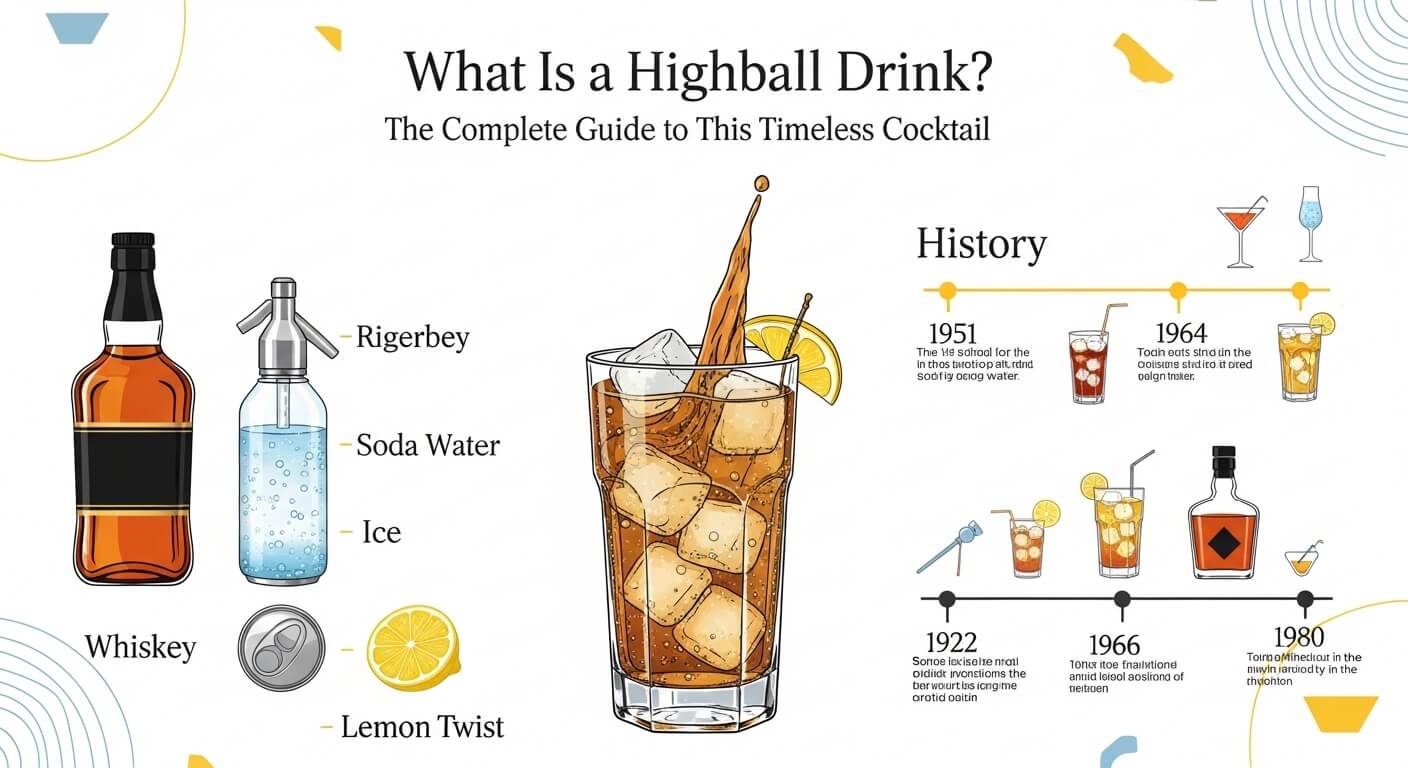
A highball is a mixed alcoholic drink composed of a base spirit and a larger proportion of non-alcoholic mixer, typically carbonated, served over ice in a tall glass. The classic ratio is 1:2 or 1:3 — one part spirit to two or three parts mixer.
The drink is defined more by its structure than by any specific ingredient. Any spirit can anchor a highball: whisky, gin, vodka, rum, tequila, brandy, or bourbon. Any non-alcoholic mixer can fill the glass: soda water, ginger ale, ginger beer, tonic water, cola, fruit juice, or lemonade. The two requirements that cannot flex are the proportions (mixer-dominant) and the vessel (tall glass, also called a highball glass or Collins glass).
What this means in practice is that gin and tonic, rum and Coke, vodka and soda, and scotch and soda are all highballs. So is the Paloma, the Moscow Mule, and the Dark and Stormy. Most people have been drinking highballs their entire adult lives without calling them that.
The Highball Glass
The glass itself is part of the definition. A highball glass is a straight-sided tumbler, typically holding 240 to 350 ml (8 to 12 oz). It is taller and narrower than a rocks glass, which keeps the carbonation in the drink longer and provides space for a generous amount of ice. Some classic guides from the 1940s specified the glass should be “admirably narrow-mouthed so the soda will not collapse ahead of schedule” — a detail that remains genuinely relevant. The Collins glass is slightly taller than the standard highball glass but is used interchangeably by most bartenders.
The Japanese Interpretation
In Japan, the word highball has a more specific meaning than in the West. There, haibōru (ハイボール) specifically refers to whisky and soda — the word is essentially a synonym for that single combination rather than an umbrella category. Other Japanese mixer-and-spirit combinations are named with the suffix -hai, so an oolong tea highball becomes ūron-hai and a shōchū highball becomes chūhai. Understanding this distinction matters if you are ordering in a Japanese bar, where “highball” will deliver whisky and soda without question.
The History of the Highball: Where It Came From
The history of the highball is genuinely contested, which is unusual for such a simple drink. Multiple people claimed to have invented it, the name has at least three competing explanations, and the drink managed to become iconic in three completely different cultures across two centuries.
The British Foundation
The highball’s earliest ancestor is the brandy and soda, which was popular in England in the early 1800s. British bartenders had been mixing spirits with naturally and artificially carbonated water since sparkling water technology advanced in the late 17th century. When Napoleonic Wars disrupted cognac supplies from France, Scotch whisky stepped in as the spirit of choice — and the combination of Scotch and soda water began its long march toward global ubiquity.
America and the Name
The name “highball” first appeared in print in Chris Lawlor’s The Mixicologist in 1895, where a drink he called the “Splificator” — a whisky and soda in all but name — appeared alongside similar concoctions. That same year, New York bartender Patrick Gavin Duffy wrote to The New York Times claiming he had been the first to serve scotch highballs in America in 1894 at a café near the Lyceum Theatre, when an English actor named E.J. Ratcliffe asked for a Scotch and soda. Duffy is also quoted in his 1934 book The Official Mixer’s Guide calling the highball “one of my fondest hopes” for a return to prominence.
By 1900, cocktail historian David Wondrich writes, the Scotch highball was the most fashionable drink in America. During Prohibition, it survived on the black market. When the liquor ban was lifted, it re-emerged as a symbol of refined drinking. Cocktail writer Dave Wondrich called the combination of “two short and one long” (the railroad signal for clear track ahead, also a rough description of the recipe’s structure) an apt metaphor for a drink that was always ready to go.
Why It Is Called a “Highball”
Three competing explanations exist, and historians cannot agree on which is correct:
- The railroad theory: On 19th-century American railroads, a metal ball raised high on a signal post meant “clear track ahead” — proceed at full speed. The suggestion is that the drink was named after this signal because it could be made and consumed quickly, or because the raised ball signalled the boiler had enough water pressure and workers took a whisky break.
- The glass theory: In the 1890s, slang, a glass was called a “ball.” A drink served in a high (tall) glass was therefore a “highball.” This is considered the most linguistically straightforward explanation.
- The Irish whisky theory: “Ball” was Irish slang for whiskey, so whiskey served in a high glass became a “high ball.” This connects to the significant Irish-American bartending community of late 19th-century New York.
None of these can be definitively proven. What is certain is that the name appeared in print in the 1890s and the drink it described had been drunk for decades before anyone named it.
Japan’s Transformation
The most remarkable chapter in highball history happened in Japan. The drink arrived there in the 1920s but became genuinely popular after World War II, when it was served cheaply at a chain of bars called Torys, founded by Suntory’s owner Shinjiro Torii. In the 1950s and 60s, it was the drink of Japanese businessmen — a way to enjoy whisky without drinking it neat during long work meals.
The highball fell from fashion in Japan in the 1980s and 90s, replaced by canned RTD (ready-to-drink) cocktails. Then, in 2008, Suntory launched a major marketing campaign featuring their Toki whisky and highball culture, and the drink staged a comeback that transformed into a cultural renaissance. Today in Japan, highball preparation is treated as a craft. Bartenders at serious cocktail bars use sweated ice (the surface moisture removed to reduce dilution), highly carbonated specific-mineral-content water, precise stirring protocols, and chilled glasses. Canned highballs are available in vending machines. Suntory even developed dedicated Toki Highball machines — described by some reviewers as producing a drink so smooth it resembles “whisky champagne.”
The Most Popular Highball Drinks

These are the highballs most likely to appear on any cocktail menu, ranked roughly by global popularity:
- Whisky and soda — The original and still the default meaning of “highball” in many contexts
- Gin and tonic — Technically a highball; one of the most ordered drinks in the world
- Rum and Coke (Cuba Libre with lime) — A global staple
- Vodka and soda / vodka tonic — Ubiquitous, particularly among those watching calories
- Scotch and ginger ale — The classic Great Gatsby-era combination
- Moscow Mule (vodka, ginger beer, lime) — Technically a highball, served in a copper mug
- Dark and Stormy (dark rum and ginger beer) — A Bermudan classic
- Paloma (tequila and grapefruit soda) — Mexico’s most popular cocktail, structurally a highball
- Seven and Seven (Seagram’s 7 whisky and 7UP) — An American classic
- Bourbon and ginger — A Southern American staple
How to Make a Perfect Highball: Step by Step
A highball looks simple enough that most people assume execution is irrelevant. It is not. The Japanese got this right: in a two-ingredient drink, every element matters more, not less.
Step 1: Choose Your Spirit
Quality matters here in proportion to the drink’s simplicity. In a complex cocktail with seven ingredients, a mediocre base spirit hides. In a highball, the spirit is fully exposed. Use something you would enjoy on its own. For a whisky highball specifically, Japanese blended whisky (Suntory Toki, Nikka From The Barrel), Irish whisky, or a lighter Scotch blended whisky works better than a heavily peated single malt, which can fight the carbonation rather than complement it.
Step 2: Chill the Glass
This is the step most people skip and it makes a significant difference. Place your highball glass in the freezer for 5–10 minutes before using, or fill it with ice water for 2 minutes and discard before building the drink. A cold glass keeps the carbonation alive longer and prevents your ice from diluting the drink rapidly.
Step 3: Add Large, High-Quality Ice
Use the largest ice pieces your glass can accommodate — a single large cube or several sizeable chunks rather than standard small crescent ice. Large ice melts more slowly, dilutes less, and maintains the drink’s temperature without rapidly watering it down. Many serious highball bars use a single large clear cube specifically for this reason.
Step 4: Add the Spirit
Pour your spirit over the ice. The standard ratio is 1.5 to 2 oz (45–60 ml) of spirit for a standard highball glass. Let it sit for 10 seconds to chill before adding the mixer.
Step 5: Add Cold Carbonated Mixer — Gently
This is the most commonly mishandled step. Pour the cold mixer slowly down the inside of the glass to preserve carbonation. Never pour from a height directly onto the ice. The goal is to disturb the bubbles as little as possible during pouring.
Step 6: Stir Once, Lightly
If you stir at all, do it once, gently, with a bar spoon. Some guides recommend not stirring at all, arguing the carbonation provides sufficient mixing. The 1949 Esquire Handbook for Hosts specifically advises to “spare the spoon and save the drink” — the metal will collapse bubbles and flatten the soda. A single gentle pass to integrate the spirit is all that is needed.
Step 7: Garnish Appropriately
Most highballs benefit from a simple citrus garnish: a thin lemon or lime wheel, or a long citrus peel expressed over the glass. This adds aromatic complexity without competing with the drink’s simplicity. Mint, cucumber, or fresh ginger work for specific combinations.
Highball vs. Lowball: Understanding the Difference
A lowball is the opposite of a highball — a spirit-forward drink served in a short rocks glass (also called an old-fashioned glass) with minimal or no mixer. Whisky on the rocks, an Old Fashioned, a Negroni — these are lowballs. The contrast is structural: highballs are mixer-dominant and refreshing; lowballs are spirit-dominant and contemplative.
Neither is superior. They serve different purposes. A highball on a summer afternoon is the correct choice; a lowball with a good single malt on a winter evening is equally right.
Common Mistakes That Ruin a Highball
Mistake 1: Using warm, flat mixer. A highball made with room-temperature soda from a bottle that has been sitting open for an hour is flat, thin, and disappointing. Keep your mixers refrigerated and open them only when you are ready to pour.
Mistake 2: Using small or bad ice. Standard freezer ice that has been sitting for days absorbs freezer odours and melts quickly. Fresh, clean, large ice makes a tangible difference in a two-ingredient drink.
Mistake 3: Drowning the spirit. A 1:5 ratio buries the flavour of the spirit entirely. The standard 1:2 to 1:3 ratio preserves the character of the base while making the drink refreshing. Going beyond 1:3 creates flavoured water rather than a cocktail.
Mistake 4: Stirring aggressively. Aggressive stirring collapses carbonation rapidly. A highball that looked perfect when poured can be noticeably flat after thirty seconds of energetic stirring.
Mistake 5: Using a warm glass. A glass straight from a room-temperature shelf makes ice melt faster, carbonation collapse faster, and the drink warm within minutes. This is the easiest fix in bartending and one of the most overlooked.
Expert Tips for Taking Your Highball Further

Tip 1: Match the mixer to the spirit’s character. Heavy, peated Scotch works better with still water than carbonated, which can amplify smokiness unpleasantly. Lighter blended whisky takes soda beautifully. Bourbon pairs naturally with ginger ale or cola. Gin finds its best companion in tonic, while light rum suits ginger beer. The pairing logic is flavour alignment — you want the mixer to extend the spirit’s best qualities, not clash with them.
Tip 2: Try flavoured sparkling waters. Yuzu soda, elderflower water, cucumber sparkling water, blood orange soda — the range of interesting carbonated mixers available today is broader than it has ever been. Pairing gin with cucumber sparkling water or using yuzu soda with Japanese whisky is an easy way to add interest without complexity.
Tip 3: Use the Japanese method as your benchmark. Even if you are not aiming for the full Japanese highball ritual, borrowing its discipline improves your result: cold glass, cold water, fresh ice, slow pour, gentle stir or no stir. These practices cost nothing and improve the drink substantially.
Tip 4: Experiment with base spirits beyond whisky. Most people’s highball vocabulary stops at whisky and soda. Mezcal with grapefruit soda is extraordinary. Aged rum and ginger beer outperforms what is a highball drink most people expect. A fino sherry highball with tonic is one of the most refreshing drinks available for summer afternoons. The structural simplicity of the highball makes it the ideal vehicle for exploring lesser-known spirits without intimidating complexity.
Key Takeaways
A highball is a spirit and a non-alcoholic mixer, served over ice in a tall glass, in a ratio that puts the mixer in the majority. That is the whole definition. Its apparent simplicity is precisely why it has endured for over 130 years across radically different drinking cultures.
Here is what matters most:
- Any spirit and any carbonated mixer can form a highball. Most popular drinks you already love — gin and tonic, rum and Coke, vodka soda — are highballs.
- Quality at every level matters more, not less, in a simple drink. Good spirit, fresh cold mixer, large clean ice, and a chilled glass separate a great highball from a forgettable one.
- In Japan, the highball is a specific drink (whisky and soda) taken seriously enough to have dedicated machines, rituals, and a place in vending machines simultaneously.
- The name’s origin is genuinely uncertain — railroad signals, slang for a tall glass, and Irish slang for whiskey are all plausible explanations.
- Pouring technique matters. Slow addition of cold mixer, minimal stirring, and preserving carbonation are what distinguish a bartender who understands the drink from one who does not.
There is a reason the highball has been at the centre of drinking culture from Prohibition-era speakeasies to mid-century Japanese offices to modern craft cocktail bars. It asks nothing complicated of you, responds generously to good ingredients and careful technique, and is ready in under a minute. Two ingredients, one glass, one hundred and thirty years. Some things work because they are simple — and the highball works exceptionally well.